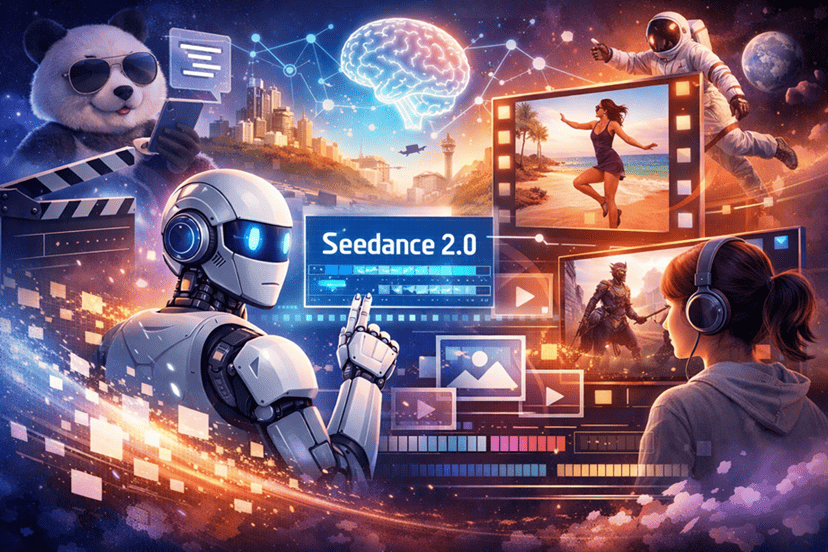
Video is the internet’s dominant medium. For years, producing high-quality video required teams, budgets, and weeks of production time. ByteDance’s Seedance 2.0 AI video model compresses that timeline to seconds.
This is not just a tool for creators; it is a category-defining generative AI platform for developers, marketers, and enterprise teams.
This technical deep-dive covers how Seedance 2.0 works, how to integrate its video AI API into your applications, and what its rise means for the future of AI marketing automation.
Table of Contents
- What Is ByteDance’s Seedance 2.0?
- How Generative AI Video Works: The Tech Stack
- Real-World Use Cases for Enterprise AI Tools
- Developer Guide: Integrating Video AI APIs
- Comparison: Text-Only AI vs AI Video Generation Software
- Marketing Implications: Scalable Content Automation
- Ethical Considerations in AI Content Creation
- The Future of AI Video Automation
- FAQ
- Conclusion
What Is ByteDance’s Seedance 2.0?
Seedance 2.0 is ByteDance’s flagship multimodal AI video generation model. It takes text prompts — and optionally, reference images — as input, and produces coherent, high-fidelity video clips as output.
It differs from earlier text-to-video AI systems in three critical ways:
- Temporal Coherence: Characters, objects, and lighting remain consistent across frames, solving the “flickering” problem of early generative models.
- Multimodal Input: It accepts both text and image references, giving users precise control over style, character appearance, and scene composition.
- Consumer-Grade Performance: While models like Sora demand enterprise-level compute, Seedance 2.0 is optimized for speed and cost-efficiency, making it viable for high-volume AI content creation platforms.
ByteDance leverages massive video datasets from TikTok to train the model, embedding deep understanding of motion physics and visual composition directly into its architecture.
How Generative AI Video Works: The Tech Stack
Understanding the mechanics helps developers evaluate the model’s capabilities for build vs. buy decisions.
Diffusion Models: The Core Engine
Modern AI video generation software relies on diffusion models. The training process involves:
- Forward Pass: Progressively adding Gaussian noise to a video until it becomes unrecognizable static.
- Reverse Pass: Training a neural network to denoise the data step-by-step, reconstructing a coherent video from random noise.
At inference time, the model starts with pure noise and refines it through hundreds of steps, guided by the text prompt, into a final video.
Transformers for Temporal Understanding
Video adds a dimension that static images lack: time. Seedance 2.0 uses transformer attention mechanisms across both spatial (pixel-level) and temporal (frame-to-frame) dimensions.
This temporal attention ensures motion consistency — the model “remembers” frame 10 when generating frame 11, rather than treating each frame as an independent image.
Multimodal Conditioning
The model is trained on paired text-video data, enabling it to map natural language descriptions to complex visual outputs. This allows prompts like “a developer typing code at night, cinematic lighting, 4k” to produce visually coherent results.
Real-World Use Cases for Enterprise AI Tools
For SaaS & Product Teams
- ** programmatic Onboarding:** Generate personalized welcome videos for new users based on their signup data.
- Feature Explainers: Automatically create video walkthroughs for new features directly from release notes.
For Marketing Automation
- A/B Testing: Generate 50 creative variations of a video ad to test hooks, pacing, and visual styles at scale.
- Localization: Instantly regenerate video content with regionally appropriate visual cues without reshooting.
For E-Commerce
- Product Demos: Convert static product images into dynamic lifestyle video clips for product detail pages.
Developer Guide: Integrating Video AI APIs
ByteDance exposes Seedance capabilities via a REST API. For JavaScript developers, integrating video AI APIs follows a standard async pattern: submit a job, then poll for results.
Node.js API Integration Pattern
const fetch = require("node-fetch");

async function generateVideo(prompt, options = {}) {
  const { duration = 5, style = "cinematic", aspectRatio = "16:9" } = options;

  // Step 1: Submit generation job to the AI Video API
  const submitResponse = await fetch("https://api.seedance.bytedance.com/v1/generate", {
    method: "POST",
    headers: {
      "Content-Type": "application/json",
      Authorization: `Bearer ${process.env.SEEDANCE_API_KEY}`,
    },
    body: JSON.stringify({ prompt, duration, style, aspectRatio }),
  });

  const { jobId } = await submitResponse.json();

  // Step 2: Poll for completion (async processing)
  let videoUrl = null;
  while (!videoUrl) {
    await new Promise((resolve) => setTimeout(resolve, 3000)); // Poll every 3s

    const statusResponse = await fetch(
      `https://api.seedance.bytedance.com/v1/jobs/${jobId}`,
      { headers: { Authorization: `Bearer ${process.env.SEEDANCE_API_KEY}` } }
    );

    const status = await statusResponse.json();
    if (status.state === "complete") videoUrl = status.outputUrl;
    if (status.state === "failed") throw new Error(status.error);
  }

  return videoUrl;
}

// Example: Generate a dynamic background for a SaaS landing page
generateVideo(
  "Abstract data visualization network, blue and purple gradients, slow motion, loopable, 4k",
  { duration: 10, style: "tech" }
).then((url) => console.log("Video Asset Ready:", url));
Building an Automated Content Pipeline
By combining Claude (Text AI) with Seedance (Video AI), developers can build fully automated content factories:
const Anthropic = require("@anthropic-ai/sdk");

async function contentPipeline(topic) {
  const client = new Anthropic();

  // Step 1: Generate optimized visual prompt via Claude
  const promptRes = await client.messages.create({
    model: "claude-3-5-sonnet-20241022",
    max_tokens: 150,
    messages: [
      {
        role: "user",
        content: `Write a vivid, specific video generation prompt for: "${topic}".
                  Focus on lighting, movement, and composition. Output prompt only.`,
      },
    ],
  });

  const videoPrompt = promptRes.content[0].text;

  // Step 2: Generate video asset
  return generateVideo(videoPrompt, { duration: 15 });
}
Comparison: Text-Only AI vs AI Video Generation Software
| Dimension | Text-Only AI (LLMs) | AI Video Generation (Seedance) |
|---|---|---|
| Output | Text, Code, JSON | MP4 Video Clips |
| Compute Cost | Low (Token-based) | High (GPU-time based) |
| Latency | Seconds (Streaming) | Minutes (Async Batch) |
| Use Case | Logic, Analysis, Writing | Marketing, Branding, Content |
| Integration | Semantic Search, Chatbots | CMS, Social Media Automation |
While text AI powers the logic of applications, AI video tools power the experience.
Marketing Implications: Scalable Content Automation
The economics of video production are fundamentally changing.
Traditional Video: High fixed costs (camera, crew, editing). Linear scaling (10 videos cost 10x more than 1). Generative AI Video: Low marginal costs. Exponential scaling (100 variations cost marginally more than 1).
Strategic shifts for marketing teams:
- Personalized Video at Scale: Generate unique video intros for thousands of email leads.
- Rapid Creative Testing: Test 20 distinct visual concepts on Facebook Ads in 24 hours.
- Global Consistency: Ensure brand guidelines are baked into the prompt templates used by global teams.
Ethical Considerations in AI Content Creation
As SaaS AI tools proliferate, ethical deployment is critical for brand safety.
- Deepfakes & Misinformation: The technology to generate hyper-realistic fake events exists. Platforms must implement C2PA watermarking and provenance tracking.
- Copyright & Training Data: The legal status of training on copyrighted video is evolving. Enterprise users should verify the indemnification policies of their AI vendors.
- Disclosure: Transparency is key. Audiences deserve to know when they are watching synthetic media.
The Future of AI Video Automation
The current 5-second clips are just the beginning. The roadmap for AI video platform technology includes:
- Long-form Narrative: Generating coherent 2–5 minute explainer videos with consistent characters.
- Real-Time Generation: Video generated dynamically based on user interactions in games or VR.
- Agentic Workflows: Autonomous agents (like OpenClaw) that script, generate, edit, and publish video content without human intervention.
FAQ
How does AI video generation work?
AI video generation uses diffusion models trained on vast datasets of video. The model learns to denoise random static into coherent frames, guided by text prompts. Transformer architectures ensure that objects and motion remain consistent over time (temporal coherence).
Is the ByteDance AI video model free?
Seedance 2.0 typically operates on a freemium or credit-based model for individual creators. For enterprise and API access, it uses usage-based pricing (cost per second of generated video).
What are the best AI video tools for developers?
Top developer-focused tools include Seedance (ByteDance), Sora (OpenAI), Runway Gen-3 Alpha, and Luma Dream Machine. Each offers APIs for programmatic generation, though availability varies by region.
Can I integrate AI video generation with JavaScript?
Yes. Most modern AI video platforms expose REST APIs that can be consumed by any Node.js or frontend JavaScript application. The standard pattern involves sending a JSON payload with the prompt and polling a job ID endpoint for the result.
What is the difference between text-to-video and image-to-video AI?
Text-to-video creates a video from scratch based on a description. Image-to-video automates motion for an existing static image (e.g., making a waterfall flow or a character smile), offering more control over the specific visual subject.
Conclusion
The ByteDance AI video model (Seedance 2.0) is a production-ready engine for the next generation of content applications. It transforms video from a scarce, expensive asset into a programmable, abundant resource.
For JavaScript developers, the opportunity is clear: build the tools that make this power accessible. Whether it’s an automated social media manager, a personalized video marketing platform, or a dynamic e-commerce experience, the video AI API is your new creative primitive.
Start Building Today: Use PlayboxJS to prototype your AI content pipelines. Test your API integrations, validate webhook payloads, and debug automation logic in a secure, browser-based sandbox.
Essential Tools for AI Developers:
- JSON Formatter — Debug complex AI API responses.
- Regex Tester — Validate prompt parsing logic.
- JavaScript Minifier — Optimize your worker scripts.
- Diff Checker — Track version changes in your prompt templates.